Showing posts with label thrift store. Show all posts

Blessed are the Thrifty

I know how to pinch a penny. I've been thrifty long enough, I recall the ridicule in middle school because of it.

The Tightwad Gazette. I can't
recommend it highly enough.
Several years ago, my brother's mother-in-law recommended The Tightwad Gazette to me, but, figuring I could've written the book myself, I brushed it off. There's something about hearing a suggestion twice. When my sister, working mightily to save for an adoption, read The Tightwad Gazette and insisted I do likewise, I devoured all three volumes in a few blissful days of non-stop reading. While others might scoff at the offbeat money-saving techniques, I took notes. With The Tightwad Gazette author Amy Dacyczyn encouraging readers to shop secondhand, I bought a needed pair of sweatpants in practically my first trip to a thrift store since childhood.

Yet I didn't eschew the Kohl's clearance racks entirely; my nascent secondhand sensibilities hadn't fully taken hold, and it still seemed superior to purchase new when steep discounts beckoned. But I experienced buyer's remorse frequently. I found a cute knit dress, which pilled and shrunk, unpresentable after its first spin in the Maytag. My husband bought a seemingly indestructible metal garden trowel, but the tip broke off. Our must-have cookware gradually lost its nonstick coating, which I assume we ingested. Most new items promised more than they delivered.

But the more I scoured the secondhand market, the more I appreciated the quality difference between new and used. With Goodwill's shelves teeming with vintage merchandise, I learned I could avoid new item failures. The phrase, "It's brand new!" started to irk me.

I love quality vintage cookware.
Used items have undergone rigorous quality testing. If the clothing will pill or shrink, it already has. If the trowel has dug decades of holes, it's unlikely to break no matter how hard-packed the soil. If Zia Francesca made her famous pasta sauce in the pot ever since her wedding day back in 1946, likely I can put it through a few more decades of home cooking, then bequeath it to my dear ones, along with the family recipes. 

Certainly, some items of yesteryear lacked quality, too, but they're already landfilled. Even if a used selection doesn't serve me long, I find solace in its life with the original owner and its comparatively low price. Unlike new goods with "no user-serviceable parts," it's likely to be repairable. When a new item bites the dust, I'm left with not only a fuller trash can, but the improvident feeling of pure, unadulterated waste--money and resources squandered in equal measure.

I'm glad some people appreciate quality vintage items,
or my shop, Laura's Last Ditch, would be out of business.
Dollars spent at a garage sale, thrift store, or estate sale stay in the local economy and compense the item only, not additional resources used to create and transport it. Buying used online supports a small business owner such as I, or assists in another's decluttering. But, purchase at a typical store, and money goes overseas, enriches a CEO (not that I begrudge the CEO, but still...), and may contribute to forced child labor or degradation of God's beautiful creation.

Buy used, and I see and feel the item, unimpeded by packaging, allowing me to detect how it has held up under normal conditions. I've prevented mounds of waste, and cut the time spent nagging my son to take out the trash. Plus, I adore the amusing unpredictability of thrift stores.
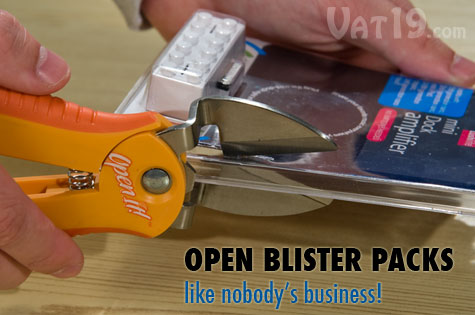
You know packaging is bad when they
sell a tool just to open it. Instead of buying
Open It!, I vote to avoid packaging altogether.
With myriad reasons to purchase secondhand, it's no wonder "It's brand new!" rubs me wrong. I don't use the phrase, lest I give the impression I consider new items superior. Children hear this and learn, if it's not new, they've received less than the best, when the opposite may be true. Really, how much is a tag worth? How much for a curse-eliciting, impenetrable plastic package? Will the $2.99 clearance shirt from Target equal the $2.99 quality shirt from Salvation Army? Even when a store price equals the used price, it doesn't mean the new one deserves a spot in the cart. Instead of considering 'new' the standard of quality, 'tested' makes a worthier standard.
My new ad for Laura's Last Ditch,
celebrating vintage quality.

Do you shop secondhand, or do typical stores still tempt you? As a new year dawns, consider joining "The Compact," or simply commit to avoiding recreational shopping, choosing used instead.

While I pinch my pennies, I'm pinching myself: rather than cursing my things as they fail, I feel blessed to have quality at a reasonable price.

Those middle school friends who ridiculed my frugal ways had a point: thrift can be ridiculous. Ridiculously good.

Next: When my 83-year-old grandma receives her first computer as a surprise birthday gift, she's not the only one Wowed.

"Army" Buddies

Secondhand shops swap newness for variety. Finding it an advantageous trade, I rarely step inside a "normal" store. I prefer the beautiful and the ugly, the vintage and the modern, the useful and the obsolete, all vying for shelf space; pans like Grandma used for family dinners; hats like Dad wore, and toys GenX-ers remember from childhood. To fully appreciate the thrift store atmosphere, I'll shop with a friend--preferably one possessing a hair-trigger sense of humor.

My friend, Tammy.
For me, that friend is Tammy.

As we browse, instead of turning to fisticuffs over the same prime merchandise, our division of labor has me taking the kitchenwares for Laura's Last Ditch, Tammy the hair styling tools for What Once Was Lost. Combining business with pleasure, we pause frequently to draw attention to our most chucklesome discoveries. Loud guffaws from the Grand Rapids Salvation Army's aisles may well mean we're shopping.

My autistic son often shops with us. With "Look at this!" our refrain, he, who utters more echolalia than useful speech, proffers arbitrary finds, mimicking the "Look at this!" he's heard so often from the two of us. When it's a plastic ice cube tray rather than a toy, I am amused, a veteran mom no longer nonplussed by his horrific deficit of meaningful communication.

I sold Bridge to Mars in my shop.
Tammy convinced me to buy it. It sold
for $40 within a couple of weeks.
Some thrift store merchandise shares a similar dichotomy of horrific yet amusing: a bare-kneed ceramic nativity shepherd, created by an amateur wanting in skill; a shark in a jar of formaldehyde; a black velvet UFO painting I feel compelled to purchase. When I shop solo and find a tacky gem, I mourn the opportunity to share with Tammy my perverse joy. Regardless, I laugh aloud, semi-consciously hoping a nearby shopper will join my merriment--though no one ever does.

Just after Christmas 2010, I find a peculiar framed photo of a boar-like creature, an attached brass plaque boasting "Javelina Club Founding Member, 1986." My prolonged gaze weighs the laughs it might receive at next year's white elephant gift exchange against its $4.99 price and a year's storage. I replace it on its hook. Tammy goads me that I "need" it, but I refuse to listen.

A javelina. Courtesy: Wes Swaincott's Short Stories
Weeks pass, yet I cannot banish the Javelina Club wall hanging from my mind. I resolve to set my usual tightwaddery aside and spring the $4.99, confident I will rescue Javelina Club from humiliating Salvation-Army-reject status. When Tammy and I return, we approach the back wall of our favorite shopping destination we lovingly refer to as "The Army," ready to laugh anew, then consummate the purchase of what will surely be next Christmas's most outlandish gem. But, it's gone. Bereft of my prize, we leave the store. My good friend shares my disappointment.

Tammy warned me I'd regret not buying it. Nearly a year later, I still, like a fisherman, consider this the one that got away.

Friends come and go. With my outspokenness, hard-to-suppress bossiness, eccentricity, and social anxiety, crowned with a phobia that makes placing a phone call an occasion for angst, I marvel that I have friends at all; indeed, I have scared off or neglected many throughout my life. So I especially appreciate Tammy, who, accepting of my many quirks and foibles, has taken the bait.

And I hope not to let this one get away.


"A friend is someone who knows all about you and still loves you."
― Elbert Hubbard

Treasures on Earth, Treasures in Heaven

Engineering certificate of William Charles Nilges.
I visit so many thrift stores, it's hard to keep them straight. But NuWay in Kalamazoo, Michigan stands out--because on my initial visit it reaked of urine; because of the prices written in wax crayon directly on the merchandise; because of a presentation so unappealing even I, a hardened thrift store junkie, consider fleeing.

I return, though, whenever I'm in Kalamazoo, because I manage to unearth a treasure on each visit. Yesterday it was a framed certificate. Issued in 1953, it declared William Charles Nilges a mechanical engineer in the State of Ohio. Its Machine Age design delights me. Though I suspect the anonymity of its recipient will hurt its prospects at Laura's Last Ditch, with a no-risk price of $3.98, I rolled the dice.

This evening, Googling "William Charles Nilges," I discovered his obituary. It took a mere month from the day he died at the age of 93 for his certificate to find its way into the shopping cart that I, with difficulty, wended through NuWay's disorganized aisles. "Bill" came from a family of ten. His wife died in '94. He held several patents for hydraulic pumps and owned a Volkswagen dealership. He served in World War II, and built steam-powered toys for nieces and nephews.

Survived by only two elderly brothers and dying childless, no niece or nephew--steam-powered toys notwithstanding--bothered to claim his mechanical engineering certificate. Feeling a sort of connection to him, I cried. Yet, there was light in one line of his obituary: "Ministering to Bill for many years have been Cathy and Jim Seiser, neighbors with huge hearts and much love." Maybe the detritus of his life went to NuWay, but he was not without friends.

Our dear neighbor, Walter.
Our nonagenarian neighbor, Walter, moved to a nursing home this past June. Walter, like William Charles Nilges, never had children. Having a speech impediment, neither did he marry. He always gave our son extra attention; because George is different, he has had a special place in Walter's heart. Every month when George's gift subscription of Highlights for Children arrives in the mail, we remember that we really should visit dear Walter.

With my only child having autism, I am likely to have no grandchildren, no descendants. Some day when I die, though few may remain to mourn my passing, I want written in my obituary, "She was a neighbor with a huge heart and much love." One who ministered. One who visited neighbors in the nursing home.

My earthly treasures may end up in a heap at the worst secondhand store in town, but my life will have mattered.


Mao's Last Blender


Being uber-frugal and anticipating the release of a new movie causes angst: bypassing the theatrical release, not wanting to buy a ticket; finding the DVD online, but choosing to save the $15; regretting my status as one of the few lacking Netflix, yet unwilling to impose upon a friend who does; waiting, waiting for the library to procure a copy, then three more interminable months in a long hold queue.

With my public library's copy of the Australian film, Mao's Last Dancer, finally in the DVD player, I lean into the screen, awaiting the scene I've rehearsed in my mind since reading the book: Li Cunxin, on a cultural exchange from China to Houston in the early 1980s, steps into the kitchen of his host's home. He sees a countertop full of small appliances and gadgets he can't even identify. It's culture shock, kitchen-style.

I received these flowers, along with a book and chocolate,
from the art department for Mao's Last Dancer. 


A couple of years ago, Marian Murray, working set design, asked me to find vintage small appliances, kitchen towels, electrical outlets, and office supplies for the film. I spent days scouring thrift stores all over the city, one by one ticking items off the list. Marian is, to date, the best customer I've had on either my eBay or Etsy sites. With sales of over $1000, I suspect I profited more than some of the bit actors; additional compensation came in the form of a book, kangaroo-shaped chocolates from Down Under, and a visit from Teleflora.

As Li approaches the kitchen, I wait to see my "babies" in at least a supporting role. But, like a soccer mom jealous of the star player, I am a bit miffed to see a blender acquired elsewhere whirr into action, while my small appliances languish in an invisible corner on a crowded countertop, mere extras. At one point, my husband says, "I think that's your outlet!" We back up the DVD a few times, but I never see it; even if I had, it would be small consolation.

I'll never again look at a period film the same way. Every vintage piece onscreen likely cost the studio dearly. And for each prop seen, fifty may go unused or unnoticed, their only legacy, conspiring to raise admission enough, a frugal person would have to sell $1000 in vintage small appliances, outlets, kitchen towels, and office supplies to rationalize the purchase of a single ticket.

A kitchen utensil
sold to Martha
Stewart Living.
Now that I've seen Mao's Last Dancer, as much as I enjoyed it, I'm glad I waited in the hold queue at the library. I saved enough money to subscribe to a magazine.

You see, I'm eagerly anticipating the centerfold featuring the kitchen utensils I sold to Martha Stewart Living.


Next: It's a sad day when I realize I can no longer get away with wearing my favorite dress: When I am Old, I Shall Wear Vintage